Supermarket Simulator Store
- 4.2
- Rating
- 10.00M
- Installs
- Free
- Price

 Analysis by App-foxy
Supermarket Simulator Store is the kind of simulation game that looks simple at first and becomes more involving once I start treating the shop as a small daily operation rather than a collection of taps. I arrange the store, serve shoppers, handle the practical side of selling, and gradually settle into the routine of keeping everything moving. That ordinary setting is its biggest strength: the game does not need a dramatic story to create a reason to continue.
Developed by iKame Games - Zego Studio, this free simulation game is aimed at a broad audience and carries an Everyone content rating. It has reached over ten million installs, with a 4.2 average from around ninety thousand ratings and roughly one thousand three hundred written reviews. Those figures suggest a game that has found a large casual audience, but they do not tell me whether the experience will suit every player. After spending time with it, I see the appeal clearly, along with the points where its relaxed storekeeping can feel repetitive.
How the supermarket turns routine into a playable mood
I find the appeal here comes from how ordinary shopkeeping can settle into a relaxed, absorbing routine: small choices about the store feel more rewarding when I make them deliberately. That makes it worth noticing not just what I do, but how I approach each visit. The next section looks at the practical decisions that help the supermarket feel more coherent.
You May Also Like

 Blood Strike: 2.5 Anniversary
Blood Strike’s Loadouts Turn Every Drop Into a Tactical Gamble
A close look at Blood Strike’s custom loadouts: how fast access to signature weapons reshapes its battle royale rhythm, rewards preparation, and narrows the gap between fights.

 Pandora - Music & Podcasts
Pandora’s Music Is Easy to Start, but Harder to Recover
Pandora’s strength is its low-effort path from a seed to a station. Its weak spot is how much confidence it asks you to place in connection, setup, and quiet recovery.

 8 Ball Pool
 Is Built on Rivalries, Rematches, and Routine
A close look at the rivalries, rematches, shared routines, and unanswered safety questions that turn a quick pool match into a persistent mobile community.

 Samsung Music
’s Quiet Strength Is Playing What You Already Own
Its reach comes less from spectacle than from dependable access to a personal library. That simplicity is both the app’s strongest retention engine and its ceiling.

 AccuWeather: Weather Radar
AccuWeather Review: A Quick, Clear Forecast for Everyday Decisions
For everyday plans, the best forecast is the one you can understand quickly. AccuWeather makes rain timing, radar, and local conditions easy to act on, with a few trade-offs.

 Hill Climb Racing
Why Hill Climb Racing Still Turns Crashes Into One More Run
A tiny car, a bumpy hill and one more upgrade: Hill Climb Racing keeps resurfacing because its simple chaos makes every near-miss feel personal.
More From Our News Desk



A first impression built on ordinary decisions
The opening appeal comes from recognition. Most people understand what a supermarket is supposed to feel like: aisles need to make sense, products should be easy to find, customers should not be left waiting, and the checkout area cannot become a bottleneck. The game turns those familiar expectations into small decisions that are easy to understand without a long explanation.
I like that the premise is immediately readable. There is no need to learn a fictional universe, remember a complicated cast, or understand a deep backstory before making progress. The store itself is the subject, and every improvement has a visible relationship with that subject. When I think about what to adjust next, I am thinking about the business as a place customers use, not just a menu of upgrades.
That accessibility makes it a comfortable choice for short sessions. I can play when I have only a little time, complete a few practical tasks, and stop without feeling that I have abandoned a complicated campaign. At the same time, the format gives longer sessions a clear rhythm because there is always another part of the shop to organize or another operational problem to solve.
The first important tip is to resist treating every available improvement as equally urgent. A tidy layout and a smooth customer path can matter more to the moment-to-moment experience than making the shop look fuller. I found that planning movement first creates a better foundation for later decisions. It is a small change in approach, but it prevents the store from becoming visually busy and functionally awkward.
A setting that communicates without overexplaining
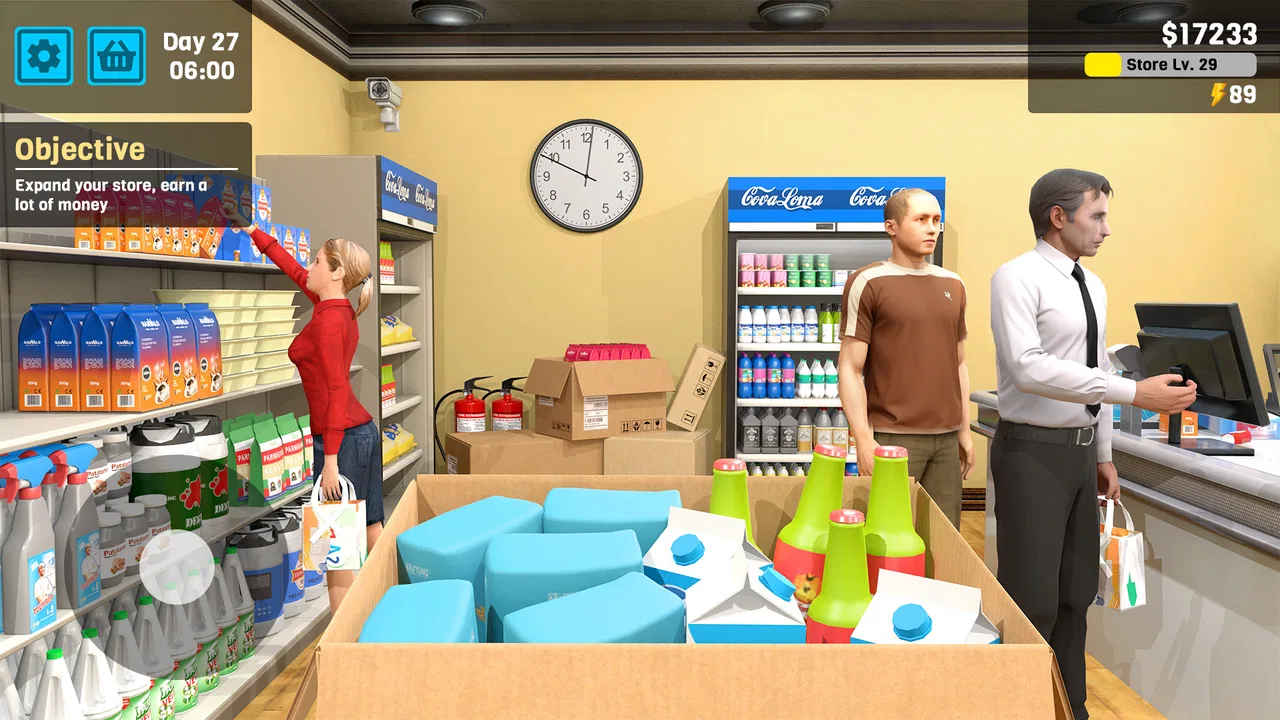
The supermarket setting does much of the storytelling through visual language. Shelves, counters, products, and open floor space communicate the state of the business more effectively than a long series of text explanations would. An empty area feels unfinished, while a well-arranged shop gives the impression that my decisions have made the business more capable.
This is where the art direction supports the simulation mechanics. The game does not need to make the store grand or glamorous. Its charm comes from the modest scale of the task. I am not managing an abstract empire; I am trying to make one everyday retail space work better. That focus keeps the atmosphere approachable and gives even small changes a practical meaning.
The visual presentation also helps distinguish progress from simple repetition. When I return to the shop, I can judge it as a physical place: where customers go, what areas feel crowded, and whether the arrangement looks intentional. That visual feedback is valuable because simulation games can otherwise reduce progress to numbers that are easy to forget.
Still, players who want a highly detailed business-management sandbox may find the setting too contained. The game’s pleasure comes from its immediate shop-floor viewpoint, not from a broad economic model or a complex corporate narrative. If your ideal supermarket game involves extensive market analysis, staff management, or a large chain of locations, this more personal storekeeping approach may feel limited.
Sound and rhythm make the work feel lighter
The sound design works best when it stays in the background and supports the routine. A supermarket is naturally associated with constant low-level activity, and the game’s mood benefits from that sense of ongoing movement. The experience feels more like a calm work session than an intense contest, which is exactly why I can return to it without needing to be in a particularly competitive mood.
Pacing is more important here than spectacle. The game gives me time to notice what is happening in the store, make a choice, and see the result. That slower rhythm suits the subject matter. A frantic pace would make the supermarket feel like an arcade challenge, while this approach keeps attention on organization and flow.
There is a useful trade-off in that calmness. It makes the game welcoming for casual players, but it can also expose repetition. Once I understand the basic routine, the atmosphere alone may not be enough to maintain interest during a long session. I prefer playing in shorter visits, especially when I want a relaxing activity rather than a demanding strategic challenge.
A realistic everyday use case is an evening break after work. I can spend a few minutes improving the layout, dealing with the immediate needs of the store, and stopping before the routine becomes tiring. It works particularly well in that space between a quick puzzle and a full management game: there is enough structure to feel productive, but not so much pressure that I need to prepare for a serious session.
Where the mechanics fit the mood
The central mechanics and the atmosphere generally agree with each other. Running a supermarket is about repetition, attention, and incremental improvement, and the game’s structure reflects those qualities. I am encouraged to think about the relationship between presentation and function: a shelf is not merely decoration, and an open area is not merely empty space. The store has to feel usable.
My strongest practical advice is to organize for the customer’s journey rather than for visual symmetry alone. A perfectly balanced arrangement is not automatically a convenient one. Leaving sensible routes between important areas can make the shop feel calmer and easier to manage. This is a small but meaningful distinction between designing a store that looks good and designing one that works.
Another useful approach is to make one change at a time when the store starts feeling inefficient. If I alter several parts of the layout together, it becomes harder to understand which decision helped and which created a new problem. Testing a single adjustment gives the simulation a more experimental quality and helps me learn the shop’s behavior instead of simply reacting to it.
The third insight is about pacing improvements. Saving every decision for a large redesign can make the store feel stuck, while changing everything too quickly removes the satisfaction of seeing cause and effect. Small, deliberate adjustments create a better rhythm. I can notice how the atmosphere changes as the business becomes more coherent, rather than treating progress as a single before-and-after event.
This is also where the game differs from many alternatives in the simulation category. A more traditional management title may emphasize spreadsheets, staff efficiency, supply chains, or long-term financial planning. Here, the emphasis is closer to the lived experience of operating the shop. That makes it easier to enter and more visually immediate, but it also means players seeking deep economic complexity should look elsewhere.
What the free model means for the experience
The game is free to download, which makes trying it straightforward. Its in-app purchases range from ninety-nine cents to twenty-nine dollars and ninety-nine cents per item. I would approach those purchases carefully and decide first whether the basic routine is enjoyable on its own. The most important question is not whether optional spending exists, but whether I still find the store satisfying when I play at my own pace.
For a casual player, the free entry point is a genuine advantage. It allows the game to serve as a low-commitment way to test the supermarket-management idea. Someone who enjoys decorating, organizing, and gradually improving a compact business may find enough here to justify continued play without immediately spending money.
For a player who dislikes in-app purchases on principle, the presence of paid items may be a reason to skip it. The game is also not the best match for anyone looking for a premium, fully self-contained simulation with a single upfront purchase. I would recommend comparing the payment model with your own tolerance before investing a lot of time, because the relaxed design can make repeated play tempting even when you planned to keep the experience brief.
Who will enjoy the atmosphere most
I think the strongest audience is made up of players who enjoy gentle management, visible organization, and familiar everyday settings. If you like arranging spaces, making gradual improvements, and watching a small operation become more functional, this game has a clear appeal. It can also work for younger players and families because the content rating is Everyone and the premise is easy to understand.
It is less suitable for people who need constant novelty. The supermarket setting is intentionally narrow, and the pleasure comes from refining a routine rather than escaping it. Players who want combat, exploration, dramatic plot turns, or highly competitive multiplayer goals will probably find the pace too quiet.
I would also hesitate to recommend it to someone who becomes frustrated by repetition or who wants every decision to have a complex strategic consequence. The game’s approachable design is part of its identity, but that accessibility comes with a lower ceiling than a specialist management simulation. It is better viewed as a relaxing store-running experience than as a complete retail-business study.
Practical details before installing
The current version is 1.5.1, and it requires Android 9 or later. That makes checking the operating system worthwhile before downloading, particularly on an older device. The game is listed for Android, and its free price makes installation easy to test without an initial purchase.
I would also consider the type of device and the way I normally play. This is a game that benefits from attention to layout and routine, so a screen that feels comfortable for visual organization will make the experience more pleasant. If I am looking for something to play in very short bursts, it fits well; if I want a deep session with a large strategic map, its compact supermarket focus may feel too restrained.
The developer name, iKame Games - Zego Studio, is worth noting for anyone who likes to follow the studio’s catalog or keep track of updates. As with any live mobile game, I would check the current store page before installing if version compatibility or purchase details are especially important to me.
My verdict on the playable mood
What stays with me is the coherence between the setting and the way the game asks me to play. The visual world is ordinary by design, the sound and pacing keep the mood relaxed, and the mechanics turn familiar supermarket problems into manageable decisions. Nothing feels as though it belongs to a completely different game. That consistency is more valuable than flashy presentation here.
The best reason to play is the satisfying connection between arrangement and atmosphere. When the shop begins to feel more orderly, the improvement is not only mechanical; it changes how the whole space reads. I can see why the game has attracted a large audience, because it offers a clear fantasy that is easy to understand and pleasantly low-pressure.
My recommendation comes with a boundary. I would suggest it to a friend who wants a calm simulation with a recognizable setting, flexible session length, and a gradual sense of ownership. I would not suggest it to someone searching for a detailed economic simulator, a story-driven game, or a purchase-free premium experience.
Overall, Supermarket Simulator Store succeeds by making routine feel purposeful. It does not transform supermarket management into something grand; it makes the small decisions feel worth noticing. For me, that is enough to make it a pleasant casual game, provided I accept its repetition, keep the in-app purchase model in mind, and play it as a relaxing shopkeeping routine rather than expecting a full-scale business simulation.
FAQs for Supermarket Simulator Store
01What is the main objective of Supermarket Simulator Store?
Supermarket Simulator Store is designed to provide users with a realistic experience of managing and running a supermarket. Players are tasked with stocking shelves, managing inventory, assisting customers, and ensuring smooth operations to grow their business. The game emphasizes strategy and time management skills to keep customers satisfied and the store profitable.
02Is Supermarket Simulator Store suitable for all ages?
Yes, Supermarket Simulator Store is suitable for all age groups. The game features intuitive controls and engaging gameplay, making it accessible for younger players while also challenging enough for adults. Its educational aspects, such as learning about money management and customer service, make it a valuable tool for children and teenagers.
03Does Supermarket Simulator Store require an internet connection?
Supermarket Simulator Store can be played offline, allowing users to enjoy the game without an active internet connection. However, certain features, such as in-game purchases or updates, may require an internet connection. Playing online also allows users to access leaderboards and compete with friends or other players globally.
04Are there in-app purchases available in Supermarket Simulator Store?
Yes, Supermarket Simulator Store offers in-app purchases. These purchases can enhance the gaming experience by providing access to additional content, such as new store items, upgrades, or special features. While the game is free to play, spending money on these extras is entirely optional and not required to progress.
05What devices are compatible with Supermarket Simulator Store?
Supermarket Simulator Store is available for both Android and iOS devices. It supports a wide range of smartphones and tablets, ensuring compatibility with most modern devices. Users are advised to check the app store for specific system requirements to ensure optimal performance and avoid any compatibility issues.
Pros
- Intuitive user interface makes navigation easy.
- Realistic graphics enhance the shopping experience.
- Wide variety of products to choose from.
- Engaging tasks and challenges keep users entertained.
- Educational elements teach budgeting and planning.
Cons
- Occasional lag on older devices.
- In-app purchases can become costly.
- Limited customization options for avatars.
- Ads can be intrusive during gameplay.
- Requires constant internet connection.

Supermarket Simulator Store
Gallery